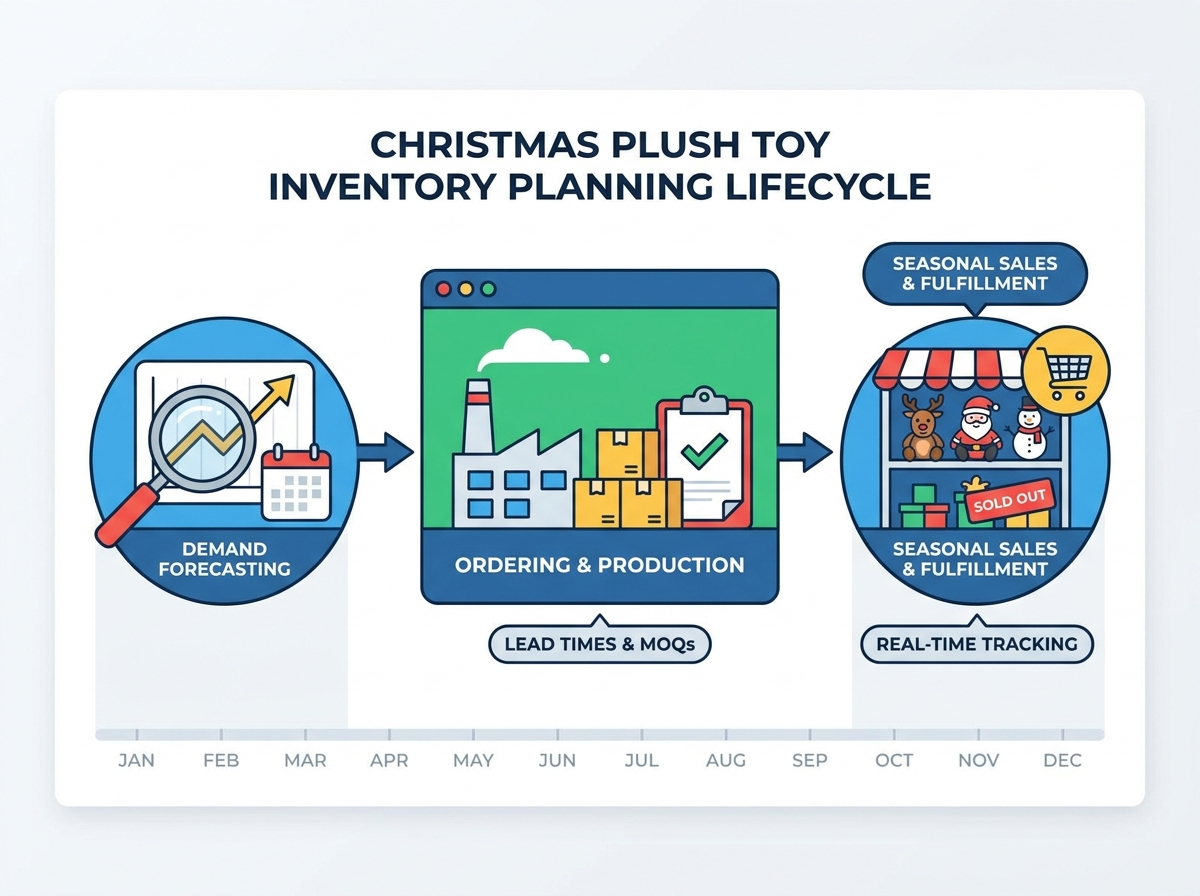
The fourth quarter retail environment leaves zero room for supply chain errors. Surging consumer demand for seasonal items frequently collides with port delays, trucking shortages, and raw material bottlenecks. Managing seasonal stock requires precision because retailers face a dual risk during this compressed window. Stockouts forfeit peak-season revenue and severely damage algorithmic visibility on e-commerce platforms. Conversely, over-ordering results in margin-killing dead stock by December 26th. Success requires a data-driven framework for planning, sourcing, and managing your Christmas plush toy inventory. Focusing on lead times, supplier evaluation, space optimization, and risk mitigation ensures profitable sell-through during the holiday rush. We will break down the exact timelines, forecasting models, and logistics strategies needed to protect your Q4 margins and keep your shelves stocked when demand peaks.
Key Takeaways
Lead Time Realities: Securing factory capacity requires finalizing holiday plush orders 4 to 5 months ahead of the seasonal window to avoid premium shipping costs.
Demand Forecasting: Accurate volume planning relies on a combination of historical sell-through data, licensing entertainment calendars, and early macroeconomic indicators.
Risk Mitigation: Protecting Q4 revenue requires diversified shipping strategies, buffer stock for high-velocity SKUs, and rigorous supplier compliance auditing to navigate backed-up ports and trucking shortages.
Margin Protection: Balancing unit costs against raw material price volatility, freight rates, and warehousing fees is critical to maintaining profitability during the compressed holiday sales window.
Table of Contents
Toggle
Christmas Plush Toy Inventory Costs: Stockouts, Margins, and Markdowns
The holiday retail timeline dictates aggressive sell-through targets. Retailers operate within a strict six-to-eight-week window to move seasonal goods. This compressed timeframe leaves zero room for logistical errors. Missing the early November shelf date means missing the initial wave of holiday shoppers, which often accounts for a massive percentage of early Q4 revenue. Late arrivals turn potential full-margin sales into immediate markdowns, destroying the profitability of the entire seasonal category.
Evergreen vs. Trend-Driven SKUs
Inventory strategies must differentiate between staple holiday characters and trend-based items. Evergreen designs like Santas, reindeer, and snowmen offer predictable year-over-year performance. You can forecast these items with high confidence based on historical data, allowing for larger, earlier ocean freight orders. Licensed or viral trend-based plush toys carry higher risk but offer massive upside. These require agile purchasing decisions closer to the manufacturing deadline and often rely on expedited shipping to hit the market while the trend is hot.
Category
Demand Predictability
Margin Potential
Markdown Risk
Sourcing Strategy
Evergreen (Santas, Snowmen)
High
Moderate
Low (Can hold for next year)
Early bulk orders, ocean freight
Licensed Properties
Moderate (Tied to media releases)
High
Moderate
Aligned with entertainment calendars
Viral/Trend-Driven
Low
Very High
High (Trend may die quickly)
Late agile orders, air freight
Choosing High-Margin vs. High-Volume SKUs
Retailers must strategically balance their assortment. Premium, high-margin statement pieces anchor visual displays and drive profitability. These are the giant, three-foot-tall reindeer or highly detailed licensed characters that draw foot traffic. Lower-cost, high-volume impulse buys generate rapid turnover at the register. Optimizing retail space means allocating the right physical footprint to each category. Bulky statement pieces consume valuable shelf space, so their higher margins must justify the real estate they occupy.
The Cost of Stockouts vs. Markdowns
Out-of-stock scenarios during peak demand carry heavy financial penalties. You lose the immediate sale and potentially alienate the customer, driving them to a competitor. On digital platforms, stockouts tank search rankings, meaning even when you restock, you have lost your algorithmic momentum. However, post-holiday surplus introduces warehousing fees and steep markdown costs. Finding the exact middle ground defines a successful seasonal strategy. You must calculate the exact cost of holding a pallet of unsold plush versus the lost revenue of running out on December 15th.
How to Forecast Christmas Plush Toy Demand
Accurate volume planning starts with auditing previous Q4 performance. You cannot guess your way to a profitable holiday season. Analyze sell-through rates, stockout dates, and category-level velocity from the prior year. Identify exactly when top-performing items sold out. This data highlights missed revenue opportunities and informs baseline ordering for the upcoming season.
Pull daily sales velocity reports from November 1st through December 24th of the previous year.
Identify the exact date your top three plush SKUs hit zero inventory.
Calculate the lost sales volume by projecting the daily velocity through the end of the season.
Audit the markdown reports from December 26th through January 15th to identify over-ordered SKUs.
Adjust the baseline order quantities for the current year based on these specific data points.
Leveraging Licensing Calendars
Align inventory planning with major Q4 entertainment releases. Licensed property schedules often dictate consumer demand spikes. A major animated movie release in November will drive massive interest in related character plush toys. Track these entertainment calendars early in the year to secure relevant inventory before factory capacity fills up. If you wait until the movie trailer drops to place your order, the factories will already be booked, and you will miss the trend entirely.
The Emotion and Trend Factor
Plush toys rely heavily on emotional appeal. Monitor social media trend-spotting to predict viral demand spikes. Certain aesthetic trends, color palettes, or nostalgic revivals can defy traditional forecasting models. Allocate a portion of your open-to-buy budget for these unpredictable, high-velocity trends. This allows your buying team to react quickly to emerging viral products in late Q3 without disrupting the core evergreen inventory plan.
Macro-Economic Factors
Inflation, raw material costs, and consumer spending forecasts must adjust baseline inventory models. When polyester and cotton costs rise, manufacturers pass those increases down the line. Tighter consumer budgets may shift demand from premium statement pieces toward smaller impulse items. Adjust your SKU mix accordingly. If economic indicators suggest a pullback in discretionary spending, weight your assortment heavier toward the $9.99 to $14.99 impulse plush rather than the $49.99 statement pieces.
Pre-Season Testing
Testing small batches of new plush designs in late Q3 provides valuable data. Place limited quantities on shelves or online to gauge early consumer interest. Use these early sell-through metrics to inform final Q4 replenishment orders. This strategy mitigates the risk of committing heavily to untested designs. If a new character design flops in October, you can cancel the secondary factory run before it ships, saving your Q4 margins.
Christmas Plush Toy Production and Sourcing Timeline
Successful holiday retail requires reverse-engineering the shelf date. Work backward from a target in-store or fulfillment center date of November 1st. Factor in transit times, customs clearance, manufacturing duration, and initial sampling. This timeline reveals exactly when you must initiate supplier negotiations. Missing a single milestone on this critical path creates a cascading delay that ends with empty shelves on Black Friday.
Factory Capacity and Lead Times
Orders must be placed by June or July to secure manufacturing slots. This four-to-five-month lead time avoids the pre-holiday factory rush. Late orders often face rejection or incur massive premium shipping costs to meet deadlines. Early commitment guarantees production capacity. Factories prioritize buyers who lock in their purchase orders early, leaving latecomers scrambling for whatever capacity remains on the secondary market.
Raw Material Price Volatility
Account for fluctuating costs in plush fabrics and stuffing. Finalize early production budgets with these variables in mind. Negotiate with manufacturers to lock in material costs early in the production cycle. This protects your margins from unexpected spikes in polyester or cotton markets. If you wait until August to finalize the fabric order, you are at the mercy of peak-season raw material pricing.
Prototyping and QA Windows
Factor in the necessary weeks for physical sampling and revisions. Safety testing and quality assurance take time. Rushing this phase leads to defective products reaching the consumer. Build a strict QA window into your critical path before authorizing mass production. You need physical samples in hand to verify seam strength, stuffing density, and facial embroidery accuracy before the factory runs ten thousand units.
Transit Time Buffers
Ocean freight requires significantly more lead time than air freight. Include realistic buffers for customs clearance and drayage delays. Ports frequently experience severe congestion in late Q3 and early Q4. Plan for these delays to ensure inventory arrives before the holiday window opens. A container sitting at the port for three weeks in November is useless to your retail operation.
Milestone
Target Completion Date
Action Required
Demand Forecasting
April 15
Analyze past data and licensing calendars.
Supplier Selection
May 15
Audit compliance and negotiate terms.
Purchase Orders Placed
June 15
Lock in factory capacity and material costs.
Mass Production Completes
August 30
Execute final third-party QA inspections.
Ocean Freight Departure
September 10
Load containers and clear origin customs.
Warehouse Arrival
October 20
Receive, sort, and allocate to channels.
How to Evaluate Christmas Plush Toy Suppliers
Establishing non-negotiable regulatory requirements is the first step in supplier evaluation. Plush toys must meet strict safety standards, such as ASTM F963 in the US or EN71 in Europe. Verify supplier certifications independently. Never compromise on safety standards, as violations result in costly recalls and brand damage. You must request recent testing reports from accredited third-party laboratories for every fabric, dye, and plastic component used in the manufacturing process.
Production Scalability
Assess a factory's ability to handle surge capacity. If early Q4 demand exceeds initial forecasts, you need a partner capable of rapid replenishment. Ask potential suppliers about their peak season capacity and their ability to expedite secondary orders. A factory running at 100% capacity in September cannot help you if a specific plush toy goes viral and you need an extra five thousand units by Thanksgiving.
Packaging and Space Efficiency
Evaluate a supplier's ability to vacuum-seal bulky plush items. Optimizing packaging reduces the dimensional weight of the cargo. This saves critical freight costs and maximizes warehouse storage space. Efficient packaging directly improves your overall profit margin. A standard shipping container might hold two thousand uncompressed large plush toys, but vacuum sealing can increase that yield to five thousand units, drastically reducing your per-unit freight cost.
Quality Control Infrastructure
Outline criteria for evaluating a supplier's internal QA processes. This includes seam strength testing, material safety checks, and openness to third-party inspections. A robust internal QA infrastructure minimizes the risk of defective products reaching your shelves.
Verify the factory conducts regular pull tests on eyes, noses, and attached accessories to prevent choking hazards.
Ensure metal detectors are used at the end of the packaging line to catch broken sewing needles.
Confirm the factory has a dedicated quarantine area for defective materials to prevent them from entering the production line.
Mandate that the supplier allows unannounced third-party inspections during the mass production phase.
Financial Stability and Track Record
Vet a supplier's historical on-time delivery rates. Assess their financial health to prevent mid-production defaults. A financially unstable factory may halt production if they cannot secure raw materials. Partner only with established manufacturers who demonstrate consistent reliability. Request references from other retail buyers and verify their export records to ensure they actually ship the volumes they claim.
How to Prevent Christmas Plush Toy Stockouts and Supply Chain Delays
Navigating freight volatility requires strategic planning. Compare the trade-offs between locking in early ocean freight contracts versus relying on spot market rates. Early contracts provide cost certainty, while spot rates offer flexibility. Diversify your approach to balance risk and cost. Relying entirely on the spot market in October is a massive gamble that usually results in destroyed profit margins due to peak season surcharges.
E-commerce and Marketplace Stockout Penalties
Out-of-stock scenarios on platforms like Amazon severely damage search rankings. Algorithmic visibility drops immediately when inventory hits zero. Buffer stock is essential for online retailers to maintain momentum. Protect your top-selling SKUs with adequate safety stock. If your hero product runs out of stock on December 10th, the algorithm will replace your listing with a competitor, and you will not regain that ranking before the season ends.
Split-Shipment Strategies
Ship a baseline percentage of your Christmas plush toy inventory via ocean freight. Reserve high-margin or high-risk SKUs for expedited air freight. This tactical advantage ensures core inventory arrives cost-effectively while allowing flexibility for trend-driven items. You might send 80% of your evergreen Santas by sea in August, and fly the remaining 20% of viral licensed characters in late October to hit a specific movie release date.
Domestic vs. Overseas Sourcing
Evaluate the cost-benefit of utilizing domestic wholesalers for rapid replenishment. Domestic sourcing offers faster turnaround times but lower margins. Direct overseas manufacturing provides higher margins but requires longer lead times. Blend both strategies to optimize availability and profitability. Keep a domestic supplier on standby to fill gaps if an ocean container gets delayed at the port.
Buffer Stock Allocation for Logistics Delays
Calculate safety stock on proven, high-velocity holiday SKUs. This insulates your operation against unexpected domestic trucking shortages or backed-up ports. Allocate more buffer stock to evergreen items that carry less markdown risk if they remain unsold after the holiday. If you over-order standard reindeer plush to act as a buffer, you can simply pack them away in January and sell them at full margin the following year.
Christmas Plush Toy Inventory Strategies to Maximize Sell-Through
Dynamically allocate plush inventory across brick-and-mortar locations, direct-to-consumer channels, and third-party marketplaces. Omnichannel fulfillment ensures inventory reaches the platform with the highest demand. Shift stock between channels based on real-time sell-through velocity. If a specific snowman plush is dead stock in your physical stores but flying off the shelves on your website, immediately recall the store inventory to your central fulfillment center.
Warehouse Space Optimization
Address the physical storage challenges of bulky plush items. Implement just-in-time routing from ports directly to distribution centers. Minimize the time inventory sits in holding facilities. Efficient space utilization reduces overhead costs. Plush toys take up massive amounts of cubic volume. Work with your logistics team to cross-dock incoming containers directly to outbound store delivery trucks whenever possible.
In-Store Merchandising and Planogramming
Maximize limited retail floor space to drive emotional, impulse purchases. Keep aisles clear while creating impactful visual displays. Position high-margin statement pieces at eye level and bulk impulse items near the point of sale. Dump bins work exceptionally well for small, low-cost plush items, encouraging customers to grab one on their way to the register without requiring neat, labor-intensive shelf stacking.
Promotional Cadence and Markdown Triggers
Establish a timeline for planned promotions around Black Friday and Cyber Monday. Set strict dates for initiating markdowns. Clear remaining seasonal stock before year-end to avoid carrying costs. Decisive markdowns are better than holding dead stock into January. If a trend-driven plush has not sold 50% of its volume by December 10th, initiate a 30% markdown immediately. Waiting until December 26th guarantees you will take a total loss on the item.
Transitioning to Q1 Seasons
Plan the physical and logistical pivot from Christmas to Valentine's Day and Easter inventory. Prevent warehouse overlap by clearing holiday stock rapidly. Smooth transitions ensure your operation remains agile and ready for the next seasonal wave. Your Valentine's Day plush inventory will arrive at the ports in late December. If your warehouse is still choked with unsold Christmas stock, you will incur massive demurrage fees at the port because you have nowhere to unload the new containers.
Conclusion
Established in 2000, Yangzhou Round Toy is an experienced custom plush toy manufacturer serving wholesalers, retailers, brands, universities, sports teams, and promotional product buyers. Supported by an approximately 8,000-square-meter factory, around 200 skilled workers, 13 embroidery machines, and monthly production capacity of up to 200,000 pieces, the company helps buyers develop and produce seasonal plush collections with scalable manufacturing and quality-focused support.
Audit last year's Q4 sell-through data immediately to identify missed opportunities and overstock issues.
Finalize licensing and trend forecasts by early Q2 to guide your purchasing decisions.
Initiate supplier negotiations and lock in factory capacity no later than June.
Implement a split-shipment strategy to balance freight costs with speed to market.
FAQ
Q: When should retailers place orders for Christmas plush toy inventory?
A: Retailers must place orders by June or July. This four-to-five-month lead time secures factory capacity before the pre-holiday manufacturing rush and allows sufficient time for ocean freight transit and customs clearance.
Q: How do licensing calendars impact seasonal plush toy demand?
A: Major Q4 entertainment releases drive massive consumer interest in related characters. Aligning inventory with these movie or show releases allows retailers to capture demand spikes for specific licensed plush toys.
Q: What are the mandatory safety certifications for importing holiday plush toys?
A: Plush toys must meet strict regulatory standards, such as ASTM F963 in the United States and EN71 in Europe. These certifications verify material safety, seam strength, and the absence of choking hazards.
Q: How can retailers prevent out-of-stock scenarios during peak holiday shopping?
A: Retailers prevent stockouts by allocating buffer stock for high-velocity SKUs, utilizing split-shipment strategies, and maintaining relationships with domestic wholesalers for rapid mid-season replenishment.
Q: How does vacuum-sealing plush toys impact freight and inventory storage?
A: Vacuum-sealing significantly reduces the dimensional weight and physical footprint of bulky plush items. This cuts ocean freight costs and maximizes limited warehouse and stockroom space.
Q: What is the best way to handle unsold seasonal plush inventory after Christmas?
A: Implement strict markdown triggers immediately after the holiday to clear stock rapidly. Liquidating remaining inventory prevents long-term warehousing fees and frees up space for incoming Q1 seasonal goods.