Selecting the correct dimensions for a plush product line is rarely a purely aesthetic choice; it is a fundamental business decision that dictates logistics, manufacturing viability, and profit margins. Misjudging scale often results in bloated volumetric shipping costs, dead retail shelf space, pattern distortion during manufacturing, or a mismatch with target audience expectations. This guide provides an evidence-based breakdown of standard animal plush toy sizes—from 4-inch mini charms to 60-inch display models—equipping buyers, retailers, and custom creators with the frameworks and size charts needed to align product dimensions with commercial objectives. We will examine the mechanical realities of fabric tension, the mathematics of freight volume, and the structural requirements that change as a pattern scales up or down.
Logistics Dictate Scale: E-commerce profitability peaks in the 10”–14” (25–35 cm) range due to the optimal balance of perceived customer value and standard polymailer fulfillment efficiency.
The "Compact Large" Threshold: The 16-inch (40 cm) mark represents the absolute ceiling for standard e-commerce shipping before heavy vacuum compression becomes mandatory.
Detail vs. Dimension Trade-offs: Mini plush toys (under 6”) require simplified designs to prevent manufacturing defects, while jumbo models require specialized internal structuring and post-decompression prep.
Volumetric Weight is the Silent Margin Killer: Scaling a plush toy from 12 inches to 16 inches does not just increase material costs; it exponentially increases the cubic volume, often doubling international freight expenses.
Compliance Scales with Size: Larger plush items face stricter safety scrutiny regarding seam tension, stuffing density, and the presence of internal armatures.
Table of Contents
Toggle
Why Animal Plush Toy Size Matters for Your Project
Defining what makes a plush size successful depends entirely on the intended distribution channel and the physical constraints of that environment. A 6-inch unit thrives inside the high-turnover ecosystem of a claw machine, whereas a premium boutique requires a 12-inch or 14-inch model to justify the physical shelf space it occupies. When you design a plush character, the physical footprint it creates in the real world impacts every subsequent step of the supply chain.
Shipping carriers calculate dimensional weight based on the package volume rather than actual mass. This means a plush toy's physical footprint often costs more to ship than the raw materials and labor required to manufacture it. Carriers use a standard formula—Length × Width × Height divided by a dimensional factor—to determine the billable weight. If you design a plush with a wide, sprawling tail or outstretched wings, you are paying to ship empty air. Compressing the design or altering the posture to a seated position can drastically reduce the cubic volume, saving thousands of dollars on a standard freight container.
Evaluating the cost per square inch of physical retail space against the visual impact required for online product photography is another major consideration. In a physical store, a bulky item takes up valuable real estate that could otherwise hold three smaller, faster-selling items. Conversely, in an e-commerce setting, a product must look substantial enough in a photograph to justify the purchase. Finding the exact dimension that satisfies both the visual weight needed for online conversions and the physical compactness required for efficient shipping is the core challenge of plush manufacturing.
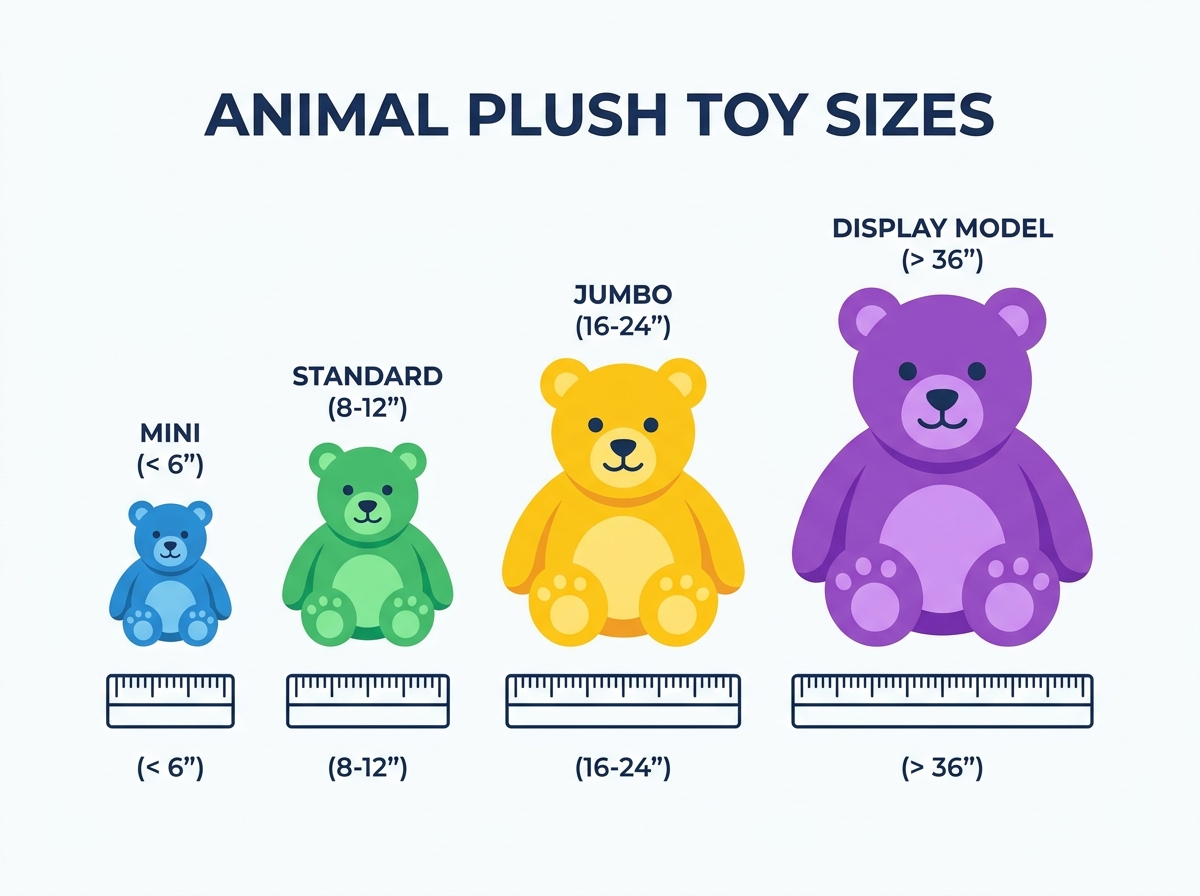
Mini and Keychain Plush Toy Sizes: 4–6 Inches (10–15 cm)
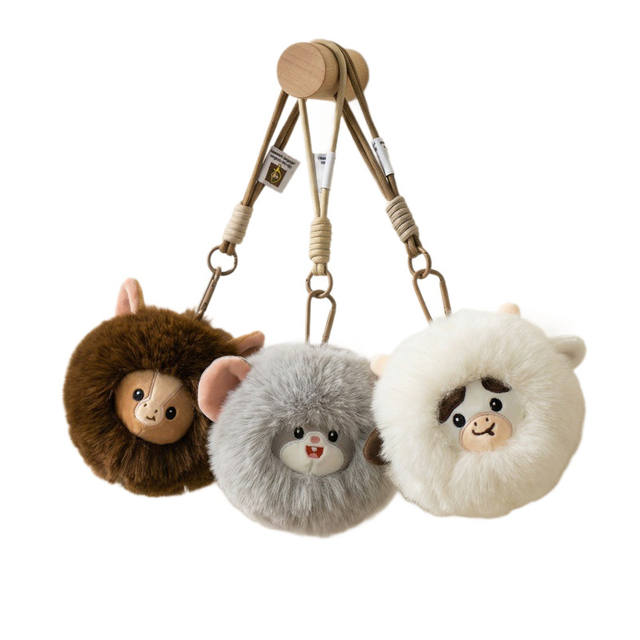
Compact, highly portable units typically range from 8 to 12 centimeters for bag charms and up to 15 centimeters for small gifts. These are heavily utilized for blind box series, promotional giveaways, and event merchandise. They fit perfectly in high-volume retail environments and serve as the backbone for claw machine inventory. At this scale, the primary goal is maximizing unit volume while minimizing individual production time.
Manufacturing trade-offs at this micro-scale require aggressive simplification. You cannot simply shrink a 12-inch pattern down to 4 inches. Complex animal features like elongated snouts, articulated paws, and intricate tails must be simplified or merged into the main body pattern to accommodate small-scale sewing. The turning process—where the sewn fabric is pulled right-side out—becomes physically impossible if the appendages are too narrow.
Standard fabrics also have severe limitations at this size. A 3mm velboa performs significantly better than long-pile faux fur. Long fibers obscure the shape of a 4-inch toy, making a bear look like an undefined puffball. Furthermore, implementation risks include a high likelihood of facial feature distortion. A millimeter of deviation on a sewing machine alters the entire expression of a mini plush.
Eliminate narrow appendages that cannot be easily turned inside out during the sewing process.
Replace complex multi-panel snouts with flat embroidered facial details.
Select short-pile fabrics like 1mm or 3mm minky to maintain silhouette clarity.
Utilize embroidery instead of plastic safety eyes to comply with choking hazard regulations on small surface areas.
Standard Retail Plush Toy Sizes: 8–14 Inches (20–35 cm)
The industry baseline for retail and custom plush manufacturing falls into this category, typically divided into Small (8-inch), Medium (10-inch), and Large (12-inch to 14-inch) tiers. The 10-inch to 12-inch medium range dominates online sales. It looks substantial and impressive in product photographs, giving the customer a sense of value, while remaining highly cost-effective to ship.
This size bracket serves as the industry standard for interchangeable plush clothing and accessories. By standardizing the body dimensions around the 10-inch or 12-inch mark, brands can create lucrative add-on revenue streams through separate outfits, hats, and magnetic accessories. The proportions at this scale allow for detailed clothing patterns that are easy for consumers to put on and take off the toy.
Standardized packaging is another major advantage. A 12-inch plush fits seamlessly into standard corrugated mailers or custom branded polymailers without requiring vacuum compression. This preserves the unboxing experience, which is critical for brand perception. You avoid the wrinkled, flattened appearance that plagues vacuum-sealed products.
Maintains structural integrity without the need for internal armatures or heavy gusseting.
Provides enough surface area for detailed embroidery, custom printed fabrics, and complex pattern work.
Fits comfortably within standard e-commerce shipping weight and volume tiers.
Allows for the integration of sound modules or battery packs without making the toy feel overly rigid.
Jumbo and Oversized Plush Toy Sizes: 16–30+ Inches (40–75+ cm)
High-impact, premium items in this category are often utilized for holiday retail, amusement park prizes, and specialty collector markets. The 16-inch (40 cm) size acts as a critical bridge. It offers the visual impact of a jumbo plush while barely remaining viable for standard online fulfillment. Once you cross the 16-inch threshold, oversized dimensions artificially inflate perceived consumer value, allowing for higher retail markups, but they introduce severe logistical hurdles.
Implementation risks require strict vacuum-sealing protocols for freight and fulfillment to control volumetric bloat. Without vacuum compression, shipping a 24-inch plush internationally will destroy your profit margins. However, vacuum sealing creates a new operational requirement: post-decompression prep. When the customer or retailer opens the package, the toy will be severely deformed.
Steaming and brushing out fabrics, especially 3mm velboa or faux fur, is necessary to eliminate deep wrinkles and restore the plush's intended shape after vacuum shipping. You must specify high-resiliency PP cotton during the manufacturing phase. Low-grade stuffing will permanently clump under vacuum pressure, leading to "stuffing shift" where the neck or limbs become floppy. Structural integrity at this scale demands internal gussets and reinforced stitching to support the increased weight of the stuffing itself.
Display and Life-Size Plush Toy Sizes: 36–60+ Inches (90–150+ cm)
Non-standard, massive units are designed primarily for visual merchandising, experiential retail, and high-end nursery decor. Utilizing life-size animal plush toys creates immediate social media photo opportunities and drives foot traffic in brick-and-mortar settings. These are not standard consumer goods; they are structural display pieces.
Evaluation dimensions include the mandatory integration of internal armatures. A 48-inch standing giraffe or bear cannot support its own weight with PP cotton alone. It requires a wire, high-density foam, or rigid plastic skeleton to remain upright. This introduces complex manufacturing challenges, as the armature must be heavily padded to prevent it from wearing through the fabric over time.
Navigating consumer safety testing involves addressing the gray area between a toy and a piece of furniture. If a plush is large enough for a child to sit on, it may be subjected to weight-bearing compliance tests under ASTM F963 or EN71 standards. Extremely low production runs and prohibitive direct-to-consumer shipping costs limit these models to wholesale or localized retail sales. The freight costs alone often exceed the manufacturing costs for life-size models.
How to Choose the Right Plush Toy Size for Production
Mapping out a multi-SKU product line requires a standardized centimeter and inch size chart to ensure visual consistency across your brand. Matching the physical dimensions of the toy to the motor skills and carrying capacity of the end-user is essential. An 8-inch model works perfectly for toddlers who need to grasp and carry the item, while a 16-inch model suits teenagers and adults looking for a display piece or a pillow-like companion.
A cost-to-margin ratio analysis helps calculate the true landed cost across different size tiers. You must factor in the manufacturing unit cost, the ocean freight based on cubic meters, and the final last-mile fulfillment cost. Often, reducing a design from 14 inches to 12 inches yields a negligible drop in perceived value but a massive reduction in fulfillment expenses.
Pattern scaling realities dictate that you cannot simply scale a 6-inch plush pattern up to 24 inches without re-engineering the proportions. Direct mathematical scaling causes a ballooning effect, where the body becomes disproportionately fat and the limbs look stubby. The pattern must be manually adjusted to maintain the correct anatomical ratios at larger sizes.
Size Category
Dimensions (Inches)
Dimensions (cm)
Primary Commercial Application
Shipping Method
Mini / Keychain
4" - 6"
10cm - 15cm
Promotions, Claw Machines, Blind Boxes
Bulk Carton (Uncompressed)
Standard Retail
8" - 14"
20cm - 35cm
E-commerce, General Retail, Accessories
Standard Polymailer
Jumbo / Oversized
16" - 30"+
40cm - 75cm+
Premium Gifting, Amusement Parks
Vacuum Sealed / Compressed
Display / Life-Size
36" - 60"+
90cm - 150cm+
Visual Merchandising, Decor
Palletized Freight
Conclusion
The optimal plush size balances design fidelity, target audience expectations, and logistical constraints. You must align the physical dimensions of your product with your specific distribution strategy to maintain healthy margins.
Finalize your design complexity and eliminate narrow appendages if targeting the 4-inch to 6-inch mini category.
Request volumetric shipping estimates from your manufacturing partner before approving any size over 14 inches.
Order a physical prototype in your exact target size to test fabric tension and stuffing density.
Implement vacuum-sealing protocols and high-resiliency PP cotton for any models exceeding 16 inches.
For brands developing plush products across multiple size categories, working with an experienced manufacturer can help refine patterns, materials, stuffing, packaging, and quality control before mass production. Founded in 2000, Yangzhou Round Toy is an established custom plush toy manufacturer with an approximately 8,000-square-meter factory, skilled production teams, specialized embroidery equipment, and extensive experience supporting wholesale, promotional, and customized plush toy projects.
FAQ
Q: What is the most popular size for retail plush toys?
A: The 10-inch to 12-inch range is the most popular for retail. This size offers a substantial feel for consumers, accommodates detailed clothing patterns, and remains highly cost-effective for standard e-commerce shipping without requiring vacuum compression.
Q: Do I need to vacuum seal my plush toys for shipping?
A: Vacuum sealing is highly recommended for plush toys 16 inches and larger. It significantly reduces volumetric weight, cutting international freight and fulfillment costs. However, it requires high-resiliency stuffing to ensure the toy recovers its shape.
Q: Can I use the same pattern for a 6-inch and a 24-inch plush?
A: No. Scaling a pattern directly causes severe proportion distortion. You must re-engineer the pattern to maintain the correct anatomical shape and prevent the plush from looking bloated or losing its intended character design.
Q: What fabric is best for mini plush toys?
A: Short-pile fabrics like 1mm or 3mm velboa are best for mini plush toys. Long-pile faux fur obscures small details, distorts the silhouette, and complicates the sewing and turning process at a micro-scale.
Q: Are plastic safety eyes safe for 4-inch plush charms?
A: Embroidery is strongly preferred over plastic safety eyes for mini plush. Surface area constraints make secure eye attachment difficult on small patterns, which increases the risk of detachment and violates choking hazard regulations.
Q: How does volumetric weight affect plush toy shipping?
A: Carriers charge based on the space a package occupies, not just its physical weight. A large, lightweight plush toy will incur high volumetric weight charges, making oversized designs extremely expensive to ship unless they are heavily compressed.